
Context
KYC needed to be resumable without making people start over
The earlier KYC flow followed one fixed sequence. Users completed KTP first, then Selfie, before moving into identity details and submission.
Autosave made that structure worth revisiting. Saving progress had limited value if users still had to follow the same order or repeat work after leaving the flow.
I designed two flow directions, set up the usability study, analyzed the behavioral and survey evidence, then translated the decision into product rules for implementation.
Autosave became more useful once saved progress changed how the flow itself behaved.
My role
My scope ran from the experiment into implementation behavior
I worked across the flow concepts, study setup, analysis, and the interaction rules needed once the selected direction moved toward production.
User journey
The journey changes once progress no longer depends on one session
This map follows the user from starting the upgrade through submission, including the moment where KYC is left and resumed later.
Journey layer
01Start upgradeUnderstand what is needed
02ReviewSee tasks and progress
03First taskComplete KTP or Selfie
04Come backResume saved progress
05Remaining taskFinish what is still incomplete
06SubmissionSend KYC for verification
User goalWhat the user is trying to achieve
Know what to prepare before starting
Understand what is complete and what still needs work
Finish one task with confidence
Continue without losing earlier work
Focus only on the unfinished task
Submit once everything is ready
User actionWhat happens in the interface
Read the upgrade benefits and requirements
Choose KTP or Selfie from Review
Capture the photo and confirm the result
Open KYC again and see the earlier task still complete
Complete the task that is still active
Check the final data and continue to verification
Experience riskWhere unnecessary repetition or uncertainty can appear
Requirements only become clear after work has started
A forced order prevents users from adapting to their current situation
It is unclear when progress is actually saved
The user expects to start again
Completed work gets repeated
The visible progress does not match what is submitted
Design responseHow the product answers that need
Show both tasks before KYC begins
Use Review as the progress hub
Save each task after the result is confirmed
Restore the state of each task when the user comes back
Keep completed work intact while the remaining task stays actionable
Bring the tasks together before the next verification step
The journey focuses on KTP and Selfie because those two tasks were the core of the Autosave experiment.
Flow exploration
We tested a fixed sequence against a flexible task hub
Both concepts saved progress. The difference was how much the surrounding KYC structure changed once that progress could persist.
Flow A
Keep the existing sequence
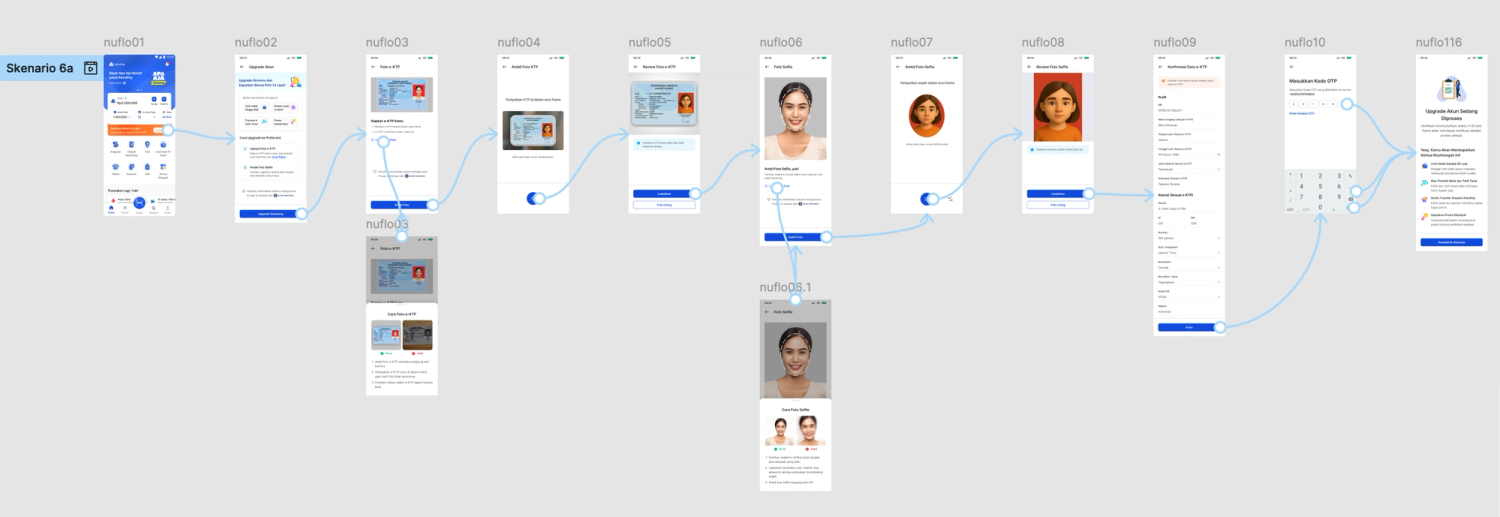
Users followed the predetermined order and the guide remained a required step before moving to the next task.
Autosave sits inside the old interaction pattern.Flow B
Turn Review into a task hub
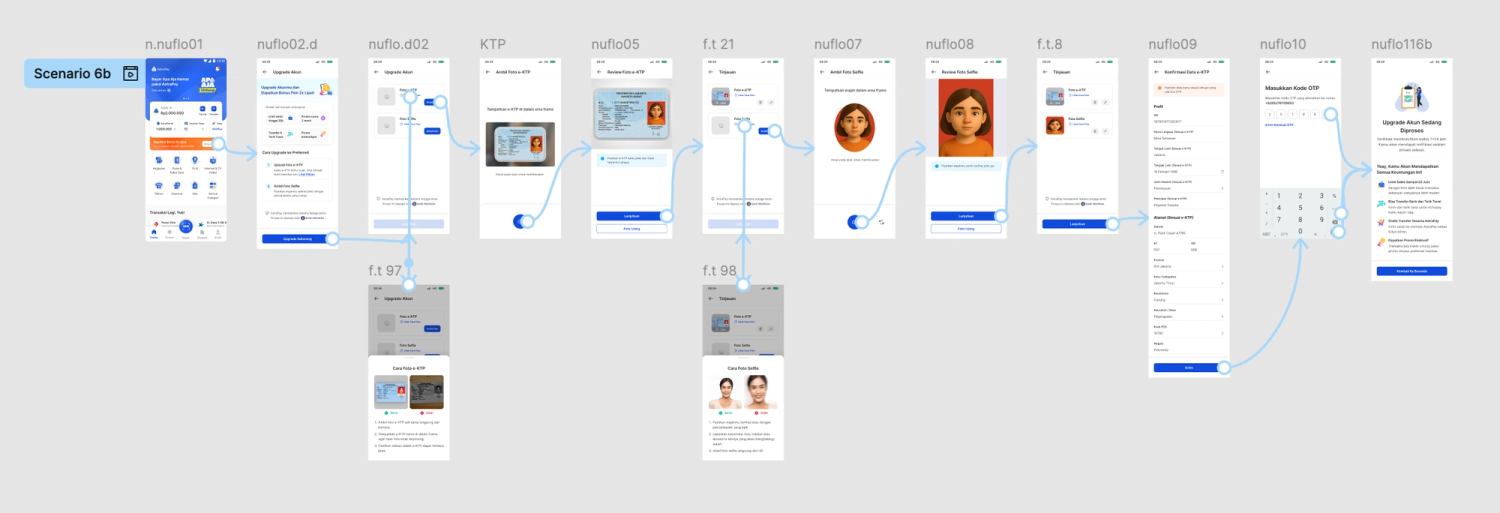
Users see the status of KTP and Selfie in one place, choose where to start, and return to the hub after completing one task.
Autosave changes the interaction structure as well as persistence.Try Flow BResearch question
The extra flexibility needed testing because it also introduced more choice
Flow B gave users more control and made progress easier to inspect. It also added a decision that did not exist in the earlier sequence.
I wanted to check whether that tradeoff made KYC harder to understand. Both directions were therefore tested as end-to-end experiences rather than compared only as wireframes.
Method
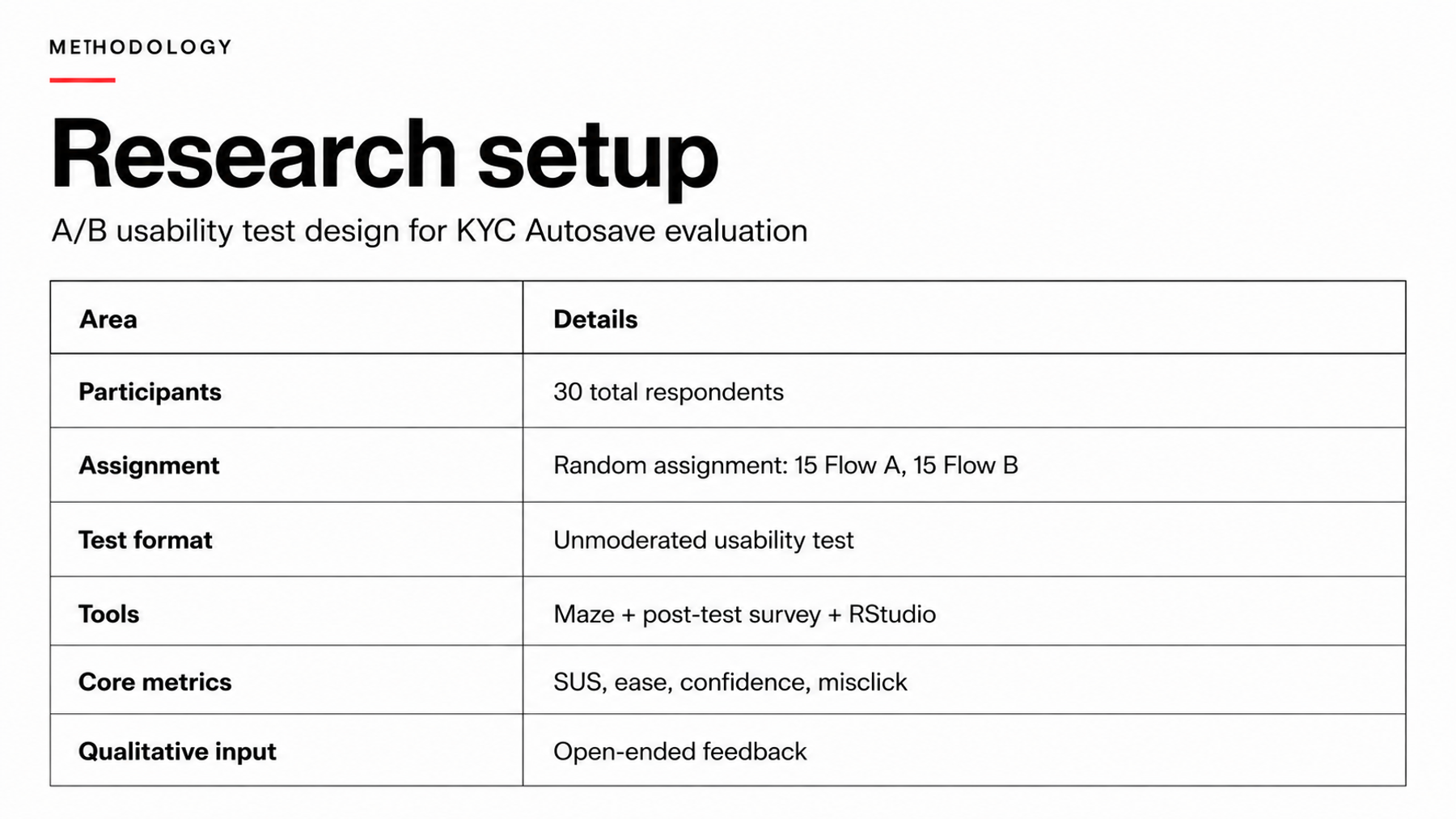
Randomized usability study with 30 participants
The study ran unmoderated in Maze and ended with a post-test survey.
Research evidence
Inspect the study setup and results
The evidence is grouped here so the study can be inspected without turning the main case into a sequence of static charts.
One randomized study across two flows
Participants completed one of the Maze flows and then answered the post-test survey.
Reading the results
The study did not produce a statistical winner
SUS and total misclicks showed no significant difference between Flow A and Flow B. Several perception measures followed the same pattern.
I then looked at the descriptive data and open feedback without treating them as inferential proof. Flow B showed a lower misclick trend, steadier confidence, and feedback that was more supportive of the progress hub.
Flow B also matched the product model better because each task was already meant to persist independently. There was no meaningful usability penalty that justified keeping the older sequence.
Flow B gave us enough confidence to move forward while staying within what the study actually supported.
Claim boundary
The product decision stayed separate from the statistical claim
The study informed the direction, but it did not justify saying that Flow B was statistically proven to be better.
Not supported
Flow B won the A B test
There was no significant difference in SUS or total misclicks, so the study did not establish a statistical winner.
The inferential result remained non-significant.Supported for the decision
Flow B was a reasonable production baseline
Usability did not meaningfully deteriorate, while the behavioral trend, feedback, and Autosave model all supported the more flexible structure.
Decision confidence came from the full body of evidence.Interactive prototype
Try Flow B starting with KTP or Selfie
This walkthrough shows the behavior that became the basis for Autosave. Choose the first task, return to Review with saved progress, then complete what remains.
TRY THE FLOW01 / 07

Set expectationsUpgrade entryThe upgrade page explains the two verification tasks before the user enters KYC.
System flow
Autosave keeps progress intact when someone leaves KYC
This flow focuses on behavior the prototype cannot show. Progress is stored per task and restored when KYC is opened again.
UserUser actions
Frontstage UIVisible product states
Autosave stateProgress that persists
VerificationHandoff after submission
entry
Enter KYCStart fresh or continue existing progress.
UI
Review reads progressKTP and Selfie keep independent status.
action
Complete one taskThe user starts with either KTP or Selfie.
saved state
Persist task stateA completed task is saved on its own.
later session
Leave and returnThe user can continue in a later session.
state
Restore progressCompleted work still appears complete.
UI
Show the remaining taskReview only asks for unfinished work.
action
Finish the last taskEarlier progress does not need repeating.
saved state
Persist complete stateKTP and Selfie are now both complete.
UI
Enable ContinueThe CTA becomes available when requirements are complete.
handoff
Send to verificationSubmission hands the data to verification.
Flow connections
- enter to review
- review to first-task
- first-task to save-first
- save-first to remaining
- save-first to leave-return, continue later
- leave-return to restore
- restore to remaining
- remaining to finish
- finish to save-complete
- save-complete to continue
- continue to verification
The interactive prototype above shows the KTP and Selfie ordering. This flow only explains the persistence and resume behavior underneath it.
Design specification
Four rules carried the interaction into implementation
These rules keep Flow B predictable when someone retakes a photo, leaves KYC, or returns in a later session.
Outcome
The study result and the production outcome are shown separately
The study directly supported the Flow B decision. Conversion moved later while several KYC improvements were live at the same time.
Not attributed to Autosave alone.
Homepage copy and other KYC changes were also live.
Broader KYC outcome
Conversion moved higher during the wider KYC improvement period
This chart provides post-implementation context. The same period also included other KYC changes.
TAKEAWAY
Flow B formed part of the experience used during this period, while the conversion uplift cannot be isolated as an Autosave-only effect.
View data
| Label | Uplift versus earlier period |
|---|---|
| Earlier period | 0% |
| Improvement-period baseline | 5% |
| Improvement-period peak | 11% |
The 5% and 11% values describe the baseline and peak uplift during the broader KYC improvement period. Homepage copy and other changes were live at the same time, so this chart is not used as a causal estimate for Autosave.
Reflection
A non-significant study can still support a strong product decision
The study did not produce a statistical winner. That made the decision boundary clearer. Flow B could move forward because usability did not meaningfully deteriorate and its behavior matched what Autosave needed to support.
A next iteration should measure resume rate, retakes by task, and completion after users return. Those measures would make the value of persistence easier to separate from other KYC changes happening around it.