AstraPay

Making KYC Resumable Without Starting Over

Autosave started as a way to keep KYC progress from disappearing when a session was interrupted. Once KTP and Selfie could be saved independently, the harder question was whether users still needed a fixed order. I tested the risk of a flexible flow and used the evidence to align the team before shipping it to production.

Role: Product DesignerKYCInteraction DesignUsability TestingSystems DesignExperimentation
The problem

Autosave exposed a bigger problem than saving progress

AstraPay KYC was built as a fixed sequence. Users completed KTP first, then Selfie, then moved into identity details and submission. When a session was interrupted, there was no reliable re-entry state.

Research around the flow showed a broader session continuity problem. People could stop because their KTP was not ready, a photo failed several times, OTP failed, or the connection dropped. Without a saved state, a small interruption could turn into work that had to be repeated.

Once Autosave entered the roadmap, I saw a more fundamental question. If KTP and Selfie could persist independently, did we still need to force the same order?

The design question was not whether we could save progress. It was whether saved progress should still live inside a fixed sequence.
Two credible directions

Linear was still valid. Flexible had to show that extra choice would not become a burden.

Linear was not a weak comparison option. Many benchmarked KYC journeys stayed sequential, especially where liveness and automated verification made one-session completion more realistic. AstraPay had a different setup, so Autosave changed the tradeoff we needed to make.

Flow A

Keep KYC linear

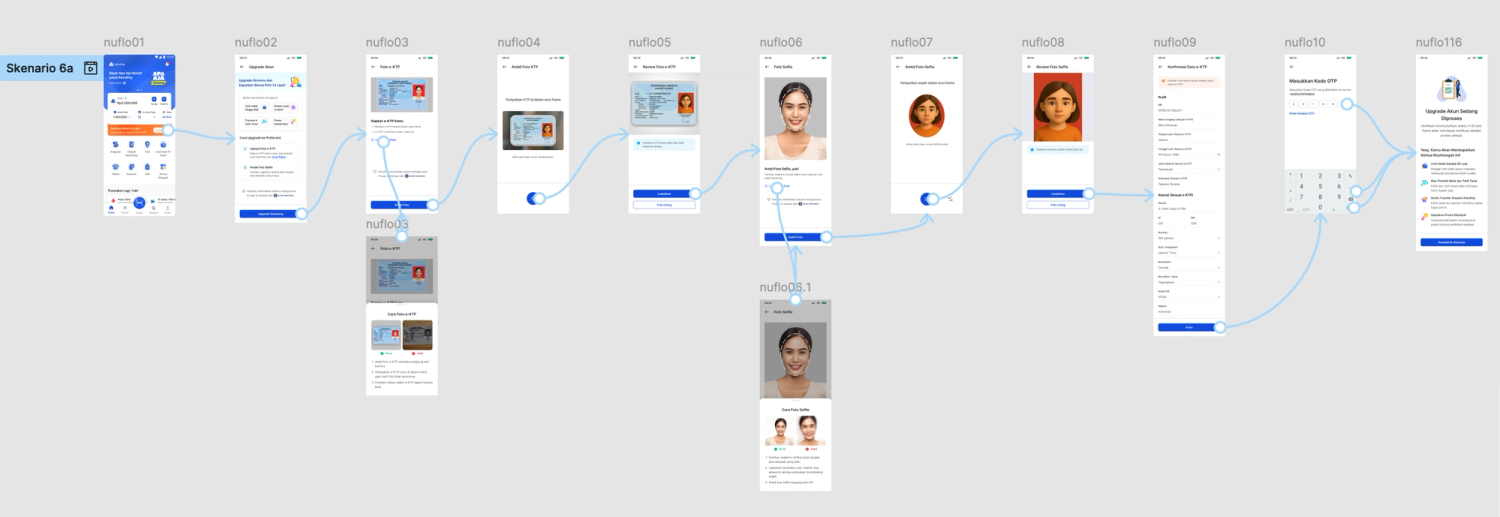
Flow A KYC with a fixed sequence

Preserve the existing sequence and add Autosave inside it. The structural change stays smaller, users face less choice, and the pattern is closer to competitor benchmarks.

Lower structural risk, weaker fit for independently saved tasks.
Flow B

Make KTP and Selfie flexible

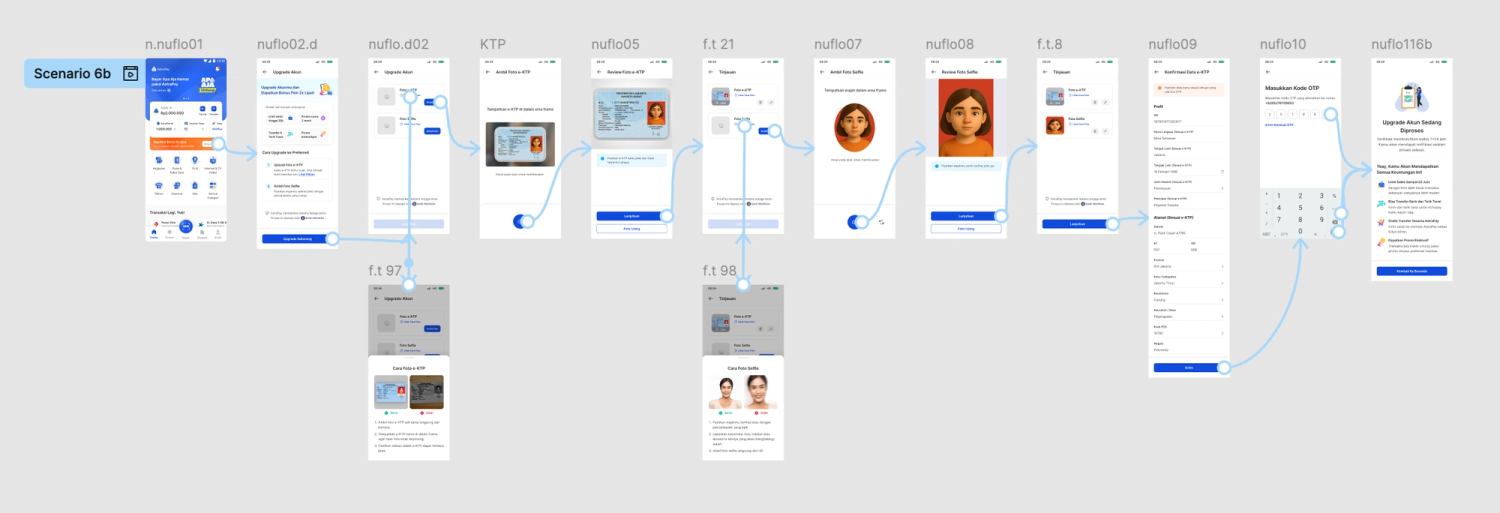
Flow B KYC with Review as a task hub

Use Review as the task hub. People can start with either capture task and still see completed work when they return.

Better fit for persistence, with a real risk of adding choice complexity.Try Flow B
The design decision

The concern was reasonable. More control could also add complexity.

I synthesized the Flexible model from workshops, existing KYC data, and constraints in our verification flow. The direction was not an automatic choice. The familiar benchmark was still linear, and there was a real concern that a task hub would make KYC harder to understand.

I took the decision case to the heads of Data, SysOps, and Product Design, then worked with the KYC team to test the main concern with evidence instead of preference.

The study had one job. Find out whether the added choice created enough usability cost to justify keeping the old sequence.
Study result

The study reduced enough uncertainty to make the production decision

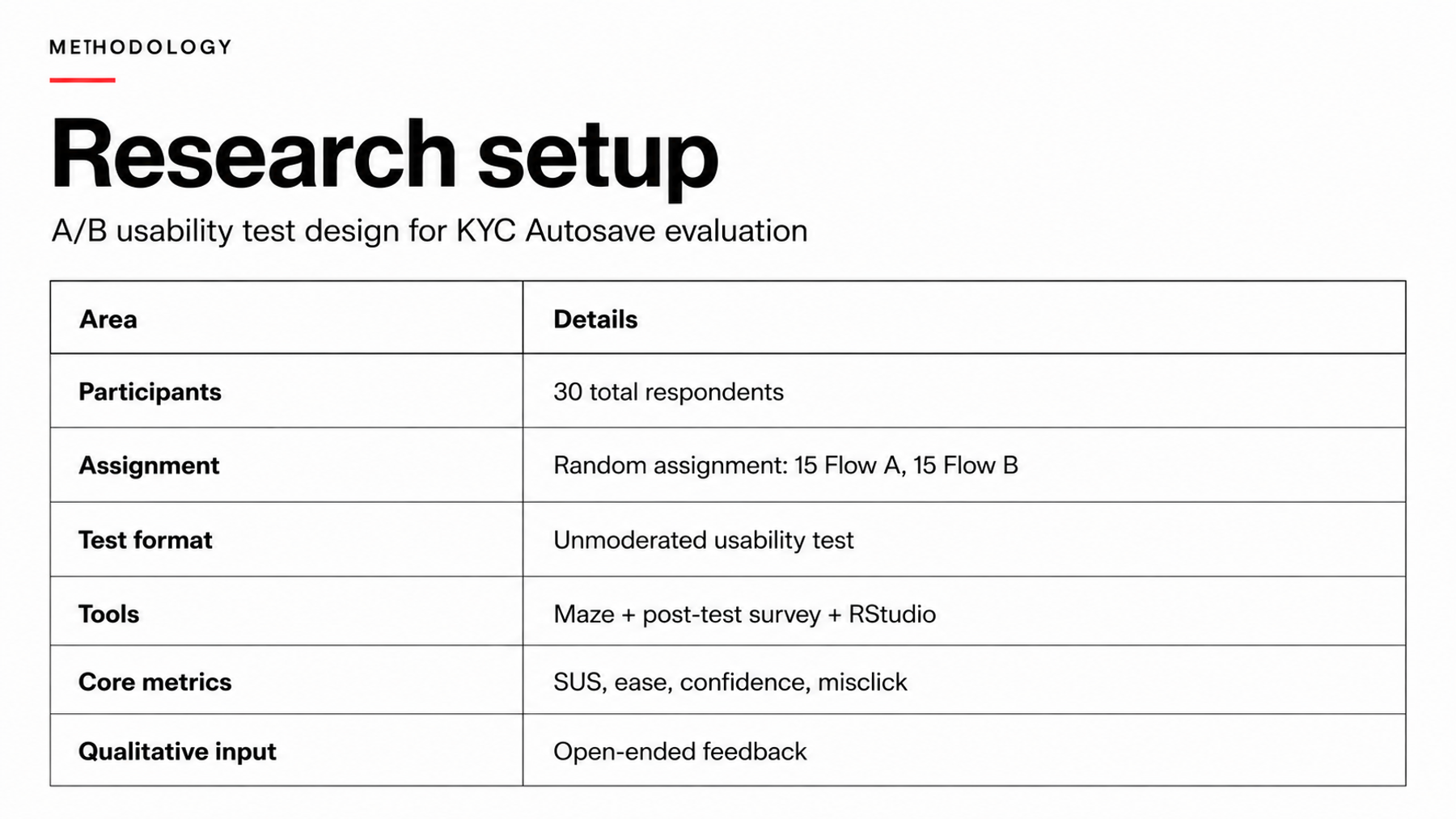
Thirty participants were randomized evenly between the two flows in an unmoderated Maze study followed by a post-test survey.

N=30participants15 Flow A and 15 Flow B
n.s.SUSno detected difference, p > 0.05
n.s.total misclicksFlow B trended lower, not significant
p = 0.02confidenceFlow B was higher in scenario 1
Evidence detail

Open the study detail if you want to inspect it further

The full setup and result views stay available without turning the main case into a sequence of charts.

One randomized study across two flows

Participants completed one of the Maze flows and then answered the post-test survey.

Randomized usability study setup for Flow A and Flow B
N 30 with 15 participants assigned to each flow.
The decision

The evidence gave us enough confidence to ship Flow B

SUS and total misclicks showed no significant difference between the two flows. Flow B still had a few supportive signals. Confidence was higher in one scenario, misclicks trended lower, and qualitative feedback was more favorable.

What changed was the quality of the discussion. We found no evidence that the added flexibility carried enough usability cost to justify keeping the old sequence. KTP and Selfie were already meant to persist independently, so the team had enough confidence to ship Flow B.

This project also became an early proof point for using inferential statistics in Product Design decisions within the KYC workstream. The numbers stopped being just presentation support. How I handled uncertainty in the data helped build trust with stakeholders.

The evidence did not prove that Flow B was always better. It helped us judge that the main risk was acceptable.
Interactive prototype

Try Flow B starting with KTP or Selfie

This walkthrough shows the behavior that became the basis for Autosave. Choose the first task, return to Review with saved progress, then complete what remains.

CHOOSE A TASK01 / 12
Home
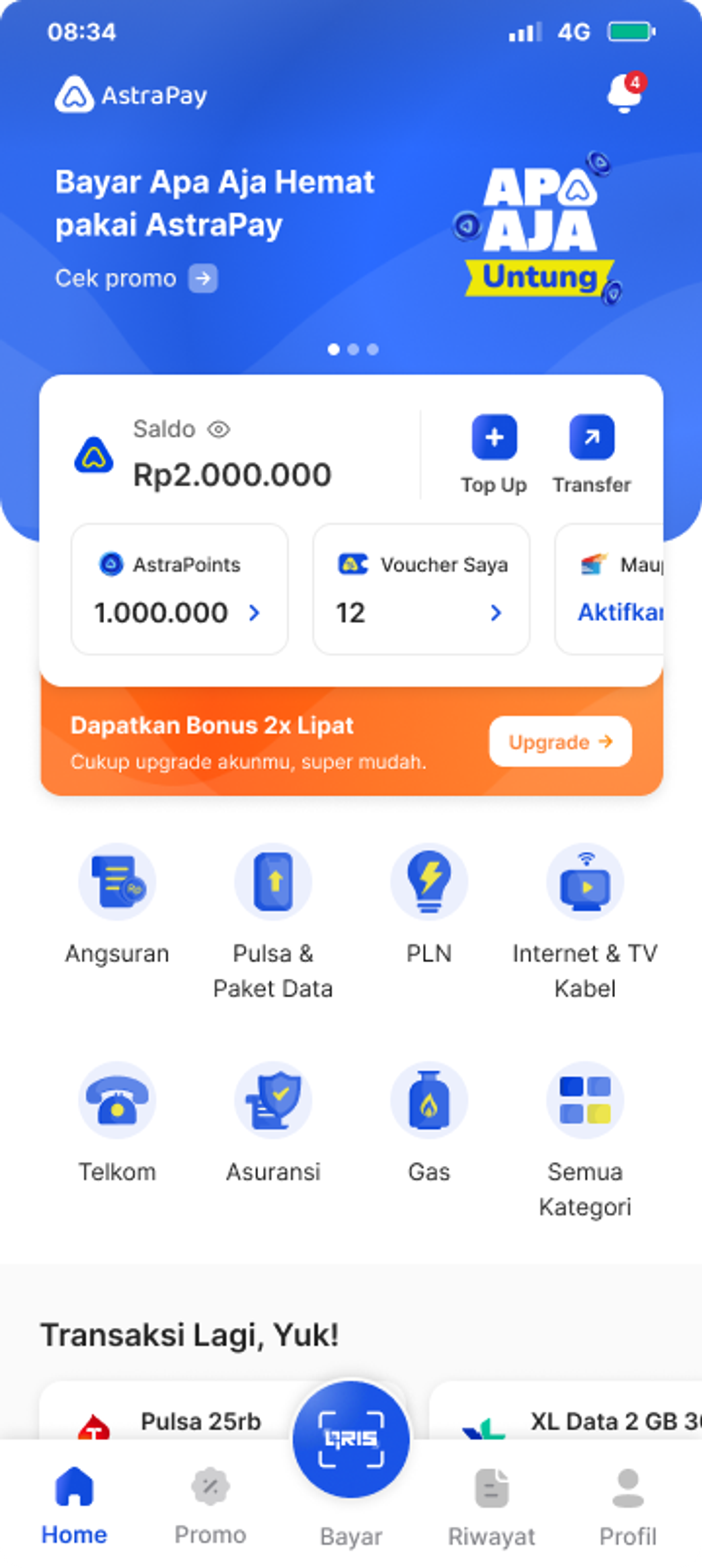
HOMEHomeMain Hook of doing KYC
What shipped

Autosave became part of the interaction model

The Flexible model started rolling out in August 2025. KTP capture and Selfie capture became the two Autosave points, so completed work could remain available when someone returned.

Flexibleproduction flowKTP or Selfie could be completed first
KTPAutosave pointprogress saved after capture
SelfieAutosave pointprogress saved after capture
Resumereturn behaviorcompleted capture remained available in a later session
Post launch monitoring

Completion rose as the new KYC experience reached more users

The first rollout in August was not a forced update. September still represented partial exposure. During the same period, the KYC homepage also ran a wording experiment and later adopted Monetary Highlight. The forced update in November widened exposure to the new KYC experience.

DERIVED · Internal KYC funnel export · September and November 2025
0102030.140.1September 2025Sep 2025 partial rolloutNov 2025 forced updateKYC completion
TAKEAWAY

+3.9% observed. This movement is read together with the sister project Testing What Makes Users Start KYC.

View data
LabelKYC completion
Sep 2025 partial rollout33.2%
Nov 2025 forced update37.1%

Both values use the same six-step post-Autosave funnel definition. The new build carried two overlapping changes during this period, Flexible Autosave and the new KYC wording. The +3.9% movement is therefore read as a combined KYC signal rather than an isolated Autosave effect.

Reflection

What I would measure next

This project did not isolate the effect of Autosave on conversion. During the same period, the homepage wording also changed through the production experiment in the sister project Testing What Makes Users Start KYC. Because both changes moved together on the same new build, the broader KYC uplift should be read as their combined impact.

The next measurement should focus on resume rate, completion after returning, and repeated capture by task. Those metrics sit much closer to the behavior Autosave was meant to improve.