
The problem
The homepage asked users to complete KYC without giving them a strong reason to start
KYC completion was sitting around 30–33%. The homepage was one of the main entry points and its KYC message had been unchanged for a long time.
We prepared a new build for a production experiment without forcing the update. Users on the new build entered one of three variants, A, B, or C. Users who had not updated continued to see the legacy message on the old build as a concurrent control cohort.
A, B, and C were assigned in the backend using user ID modulo three. The legacy cohort was not part of the same randomization, so I separated evidence from the randomized arms from comparisons against the old build.
The question was simple. Which framing would make more users enter KYC and keep moving through submission?
Experiment design
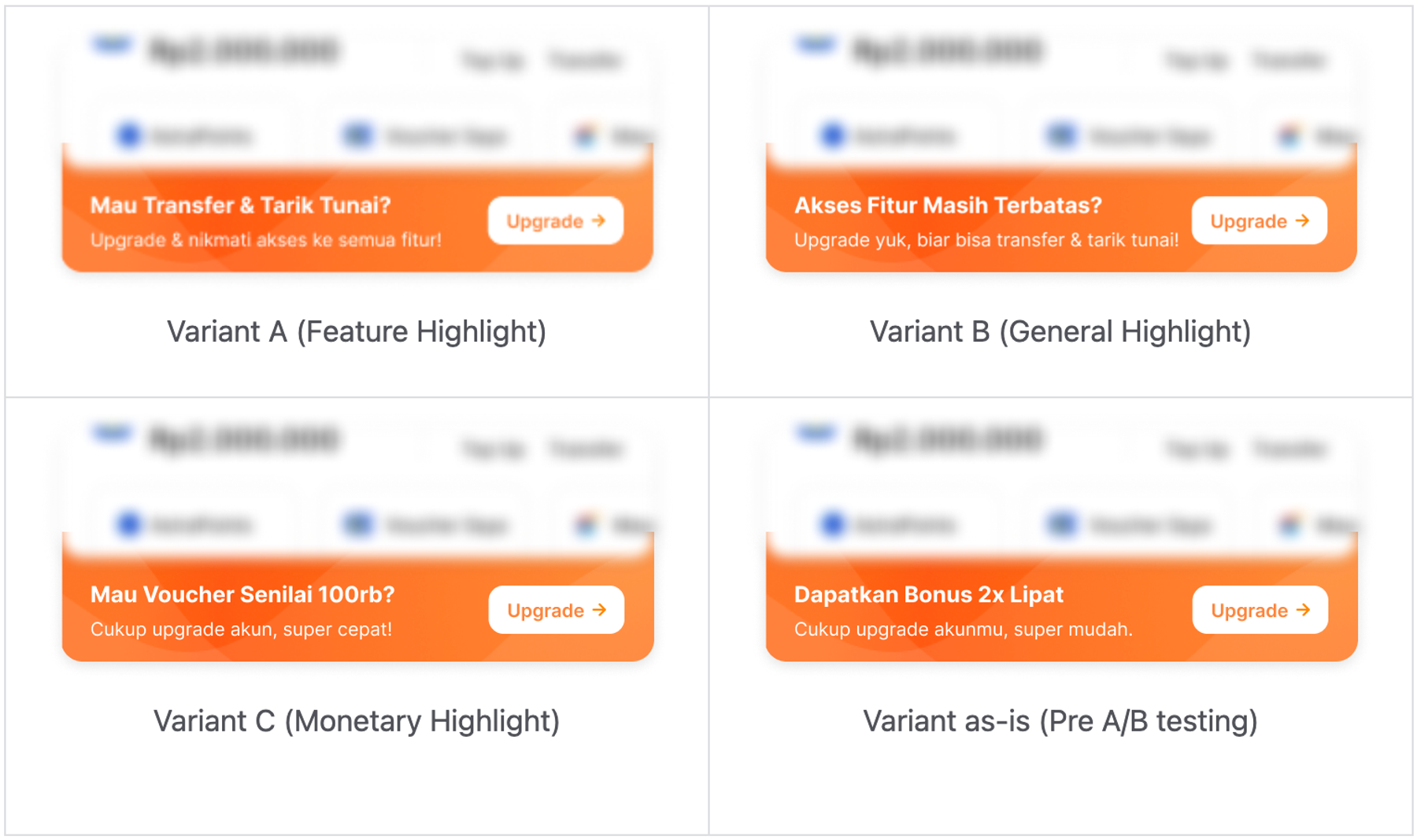
Three variants tested three different reasons to start KYC
I worked with the UX Writing team to create three framings with meaningfully different value propositions, not cosmetic rewrites.
Randomized arm results
C was strongest at entry. Final conversion across A, B, and C remained statistically similar.
I separated the response at entry from the final conversion rate so the decision did not collapse into one CVR number.
Experiment evidence
See the variants and production result
The visual detail stays available for anyone who wants to inspect the messages and the full result.
A, B, and C ran on the new build while legacy stayed on the old build
A, B, and C were randomized production arms. The legacy message came from the old-build cohort that remained active because the update was not forced.
How I read the test
More KYC starts only mattered if users kept moving after entry
The business KPI focused on submission volume. I still read the funnel from exposure through submission so an entry gain did not hide a larger drop after users entered.
Experiment arm
A, B, or CA user on the new build enters one randomized arm.
Entry behavior
KYC StartDoes the framing move more users into the flow?
Downstream check
ProgressionDo the additional starters keep moving through KYC?
Business KPI
SubmissionDoes the extra entry translate into more submissions?
Flow connections
- exposure to start
- start to progress
- progress to submit
Raw submission count was read alongside exposure and conversion rate. More volume did not automatically mean a variant was more efficient.
Decision
B had the highest final CVR. I still recommended C.
Our KPI prioritized submission volume. Final CVR across A, B, and C was not significantly different, so B's small descriptive lead was not strong enough to decide the rollout on its own.
Variant B
Highest final CVR descriptively
B recorded a 37.36% final CVR, slightly above A and C.
B's final lead was not statistically significant, so I did not treat it as a proven winner.Variant C, shipped
Strongest entry response with no detected downstream downside
C significantly outperformed A at KYC Start and stayed close to B. Downstream conversion did not show a significant decline after users entered.
With submission volume as the KPI, C gave stronger evidence for increasing entry without evidence that traffic quality deteriorated.Product decision
The recommendation for C went through senior review and final CMO confirmation
The result did not produce one clean winner. I took the decision case to the heads of Design, Data, and SysOps by separating what was statistically supported, what was only numerically highest, and how each signal related to the submission KPI.
The final recommendation was Monetary Highlight. It received final confirmation from the CMO and C replaced the legacy message as the main production direction.
B remained a useful fallback because it did not depend on a voucher and had the highest final CVR descriptively. That gave the team an option if the promotion ended or C performance declined.
The rollout followed the KPI and the strength of the evidence. B had the highest final number. C had the stronger entry evidence.
Combined KYC impact
The new build stayed above legacy across every KYC checkpoint
From 2 to 30 October, Variant C on the new build was compared with the legacy cohort on the old build. The same new build also carried Flexible Autosave from the sister project Making KYC Resumable Without Starting Over. Because both changes moved together, this chart is read as a combined rollout signal rather than an isolated wording effect.
New buildLegacy old build
TAKEAWAY
The new build stayed above legacy across every checkpoint. This uplift is read as the combined impact of the new KYC wording and Flexible Autosave.
View data
| Funnel checkpoint | New build | Legacy old build |
|---|---|---|
| Start after landing | 70.53% | 64.01% |
| Submit after landing | 40.28% | 34.12% |
| Overall submit | 37.53% | 34.12% |
Legacy and new build are compared across the same funnel checkpoints. The new build also carried Flexible Autosave, so these differences are not used as isolated wording impact.